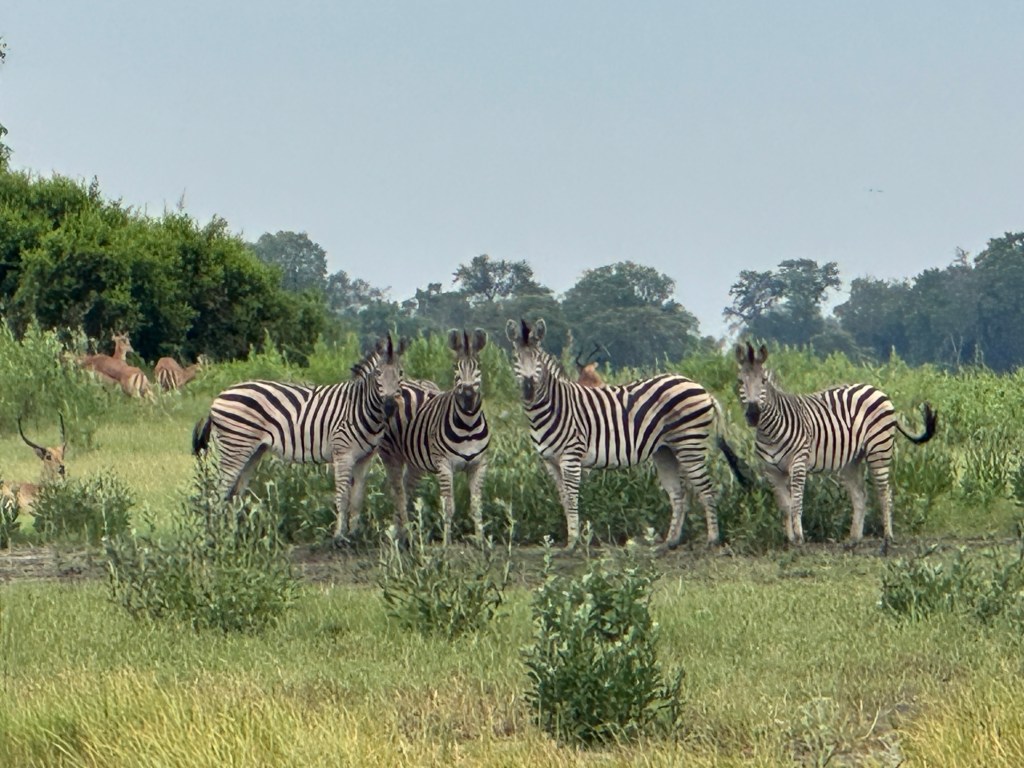
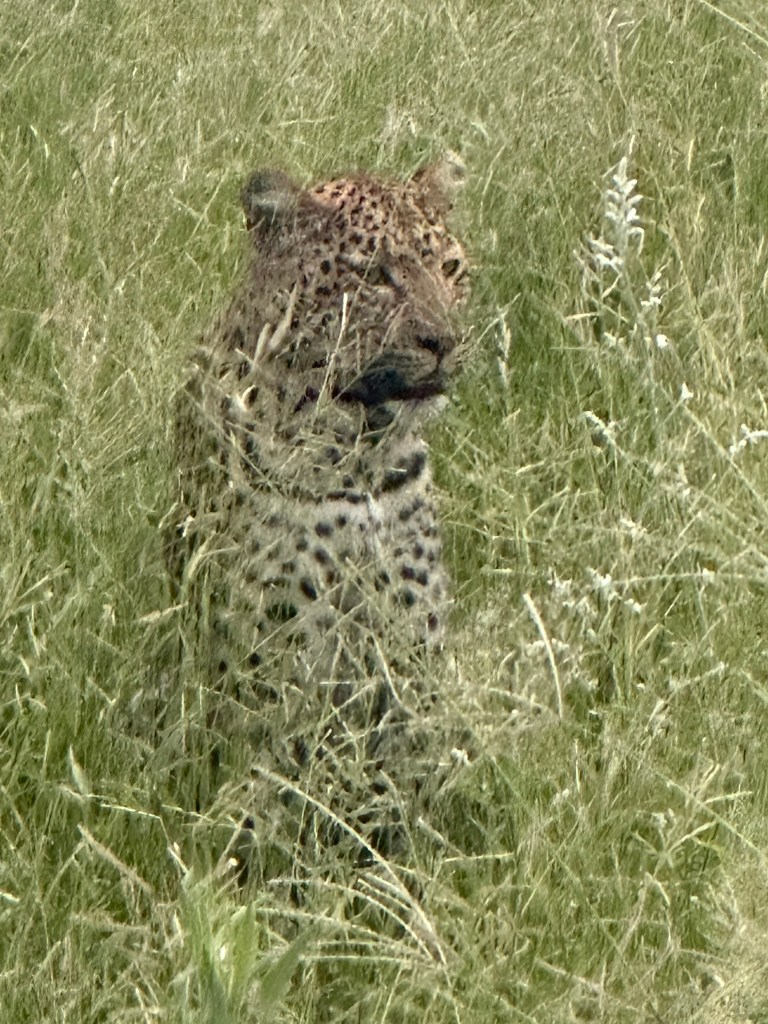
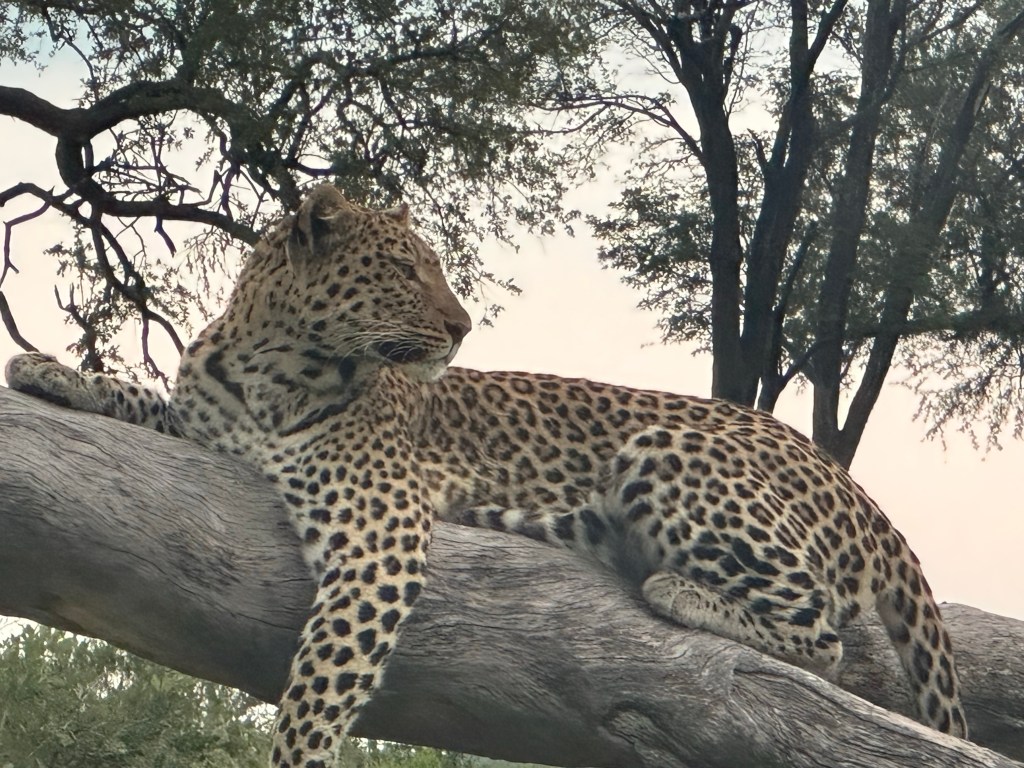
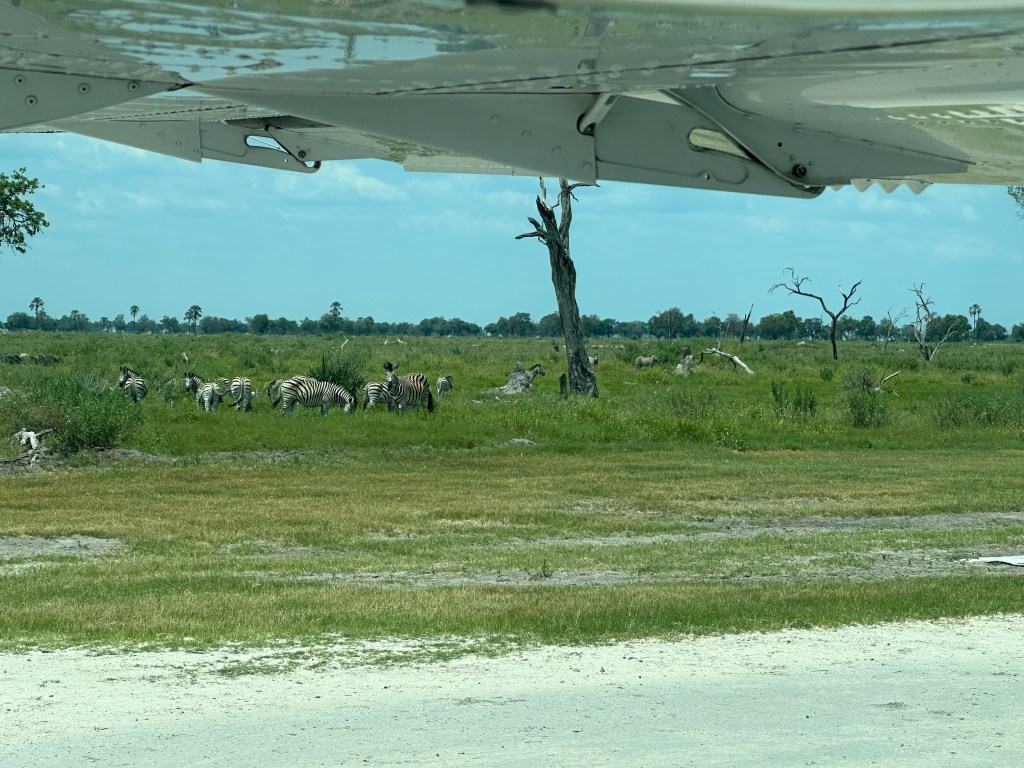
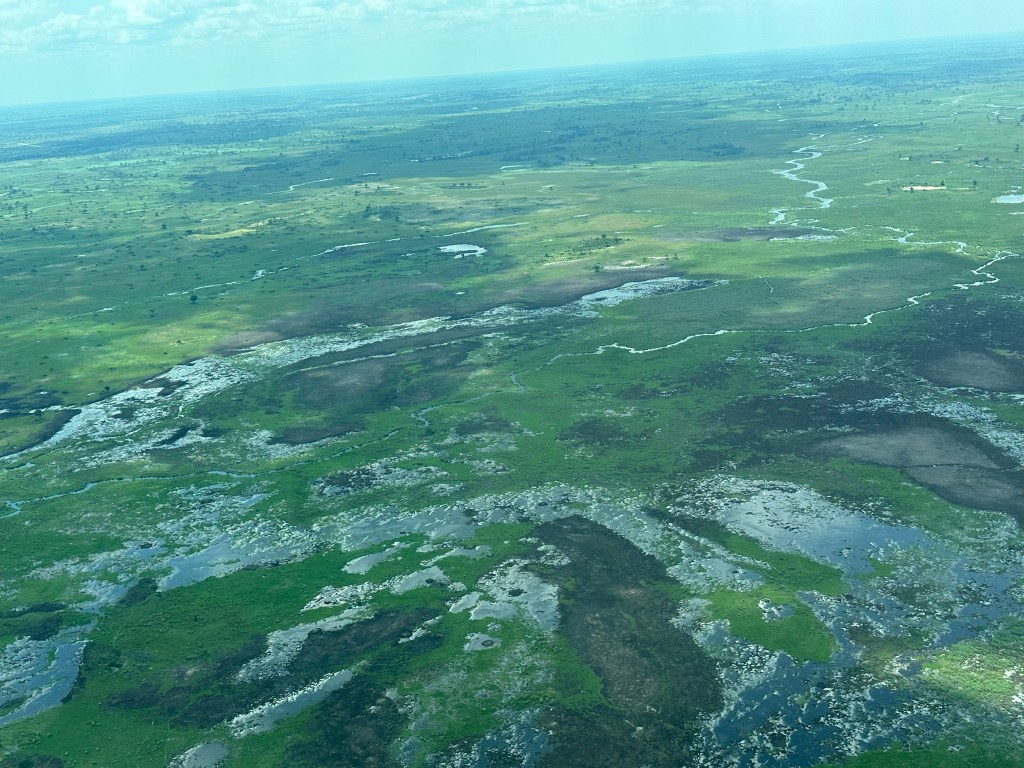
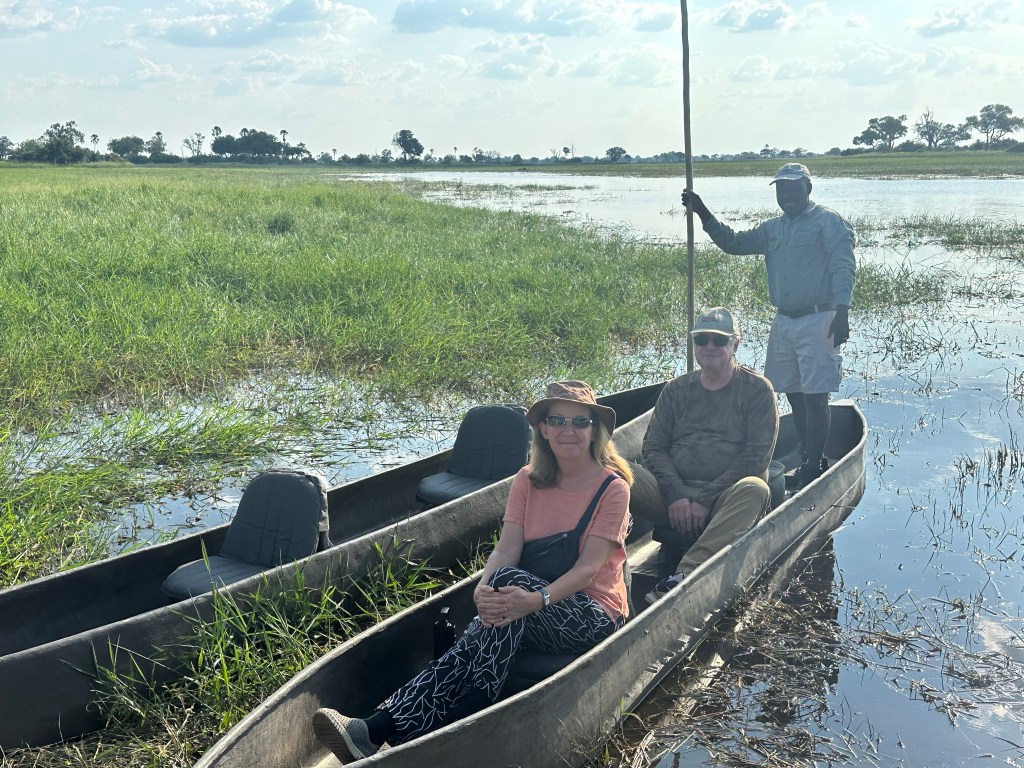
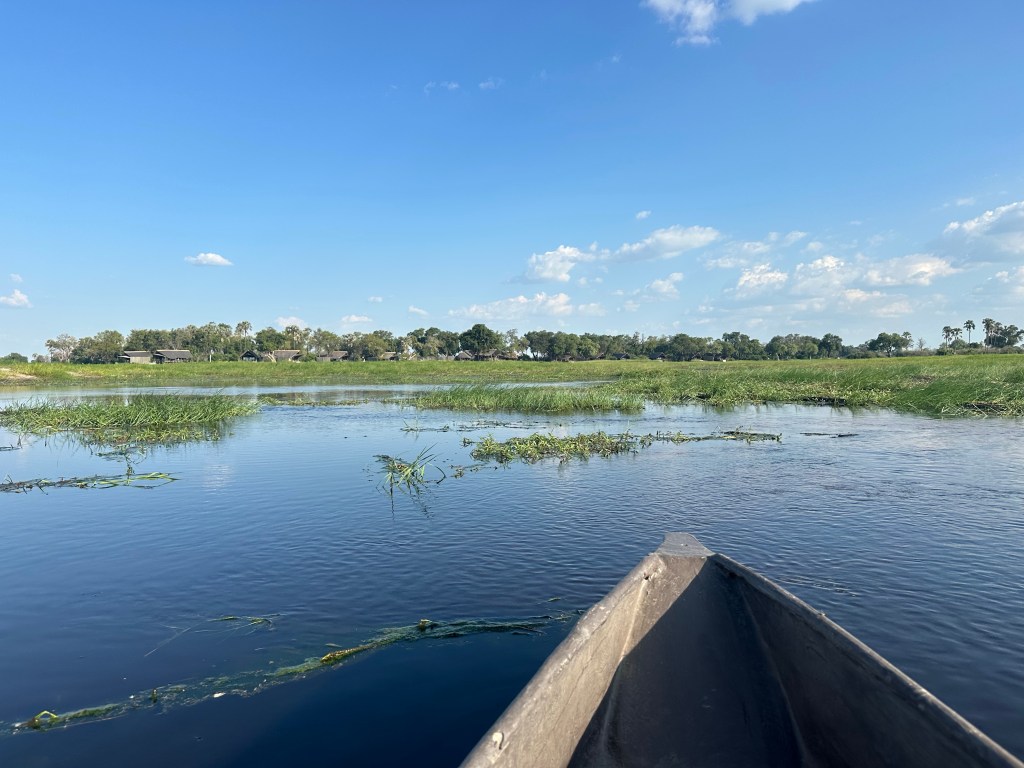
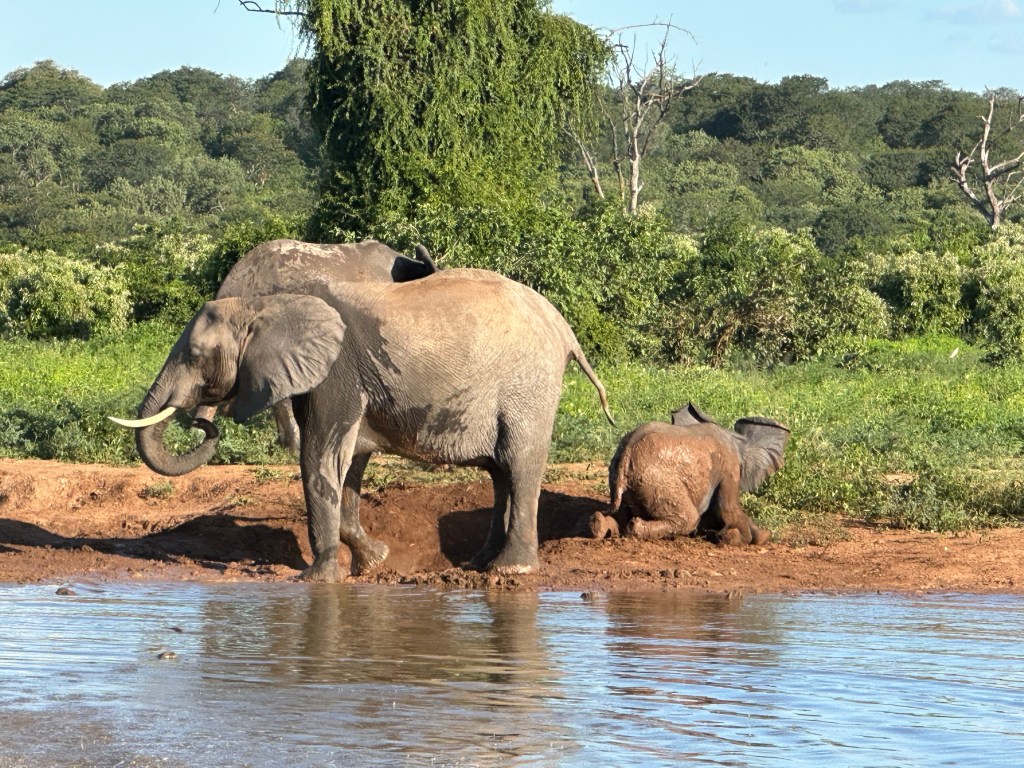
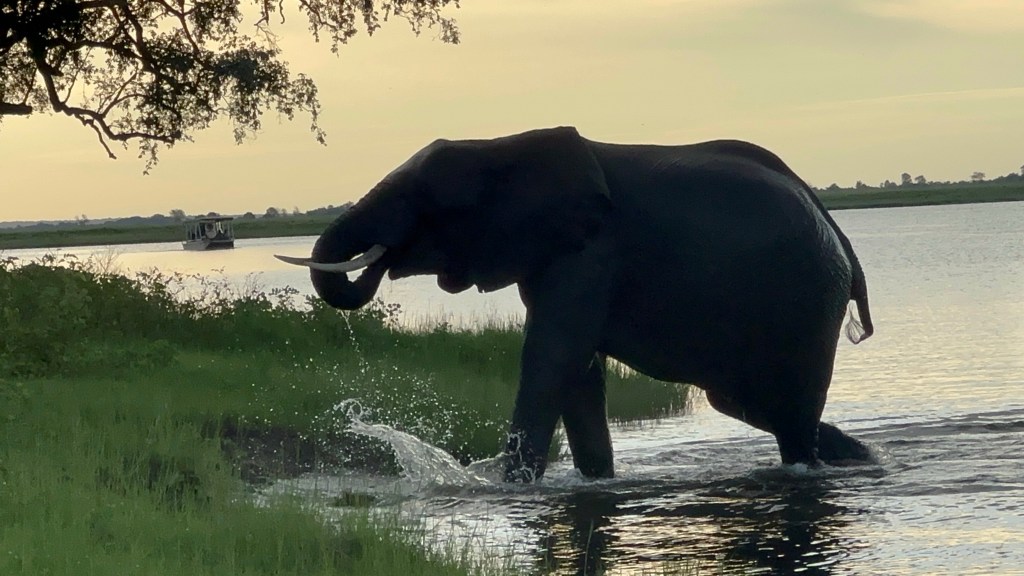
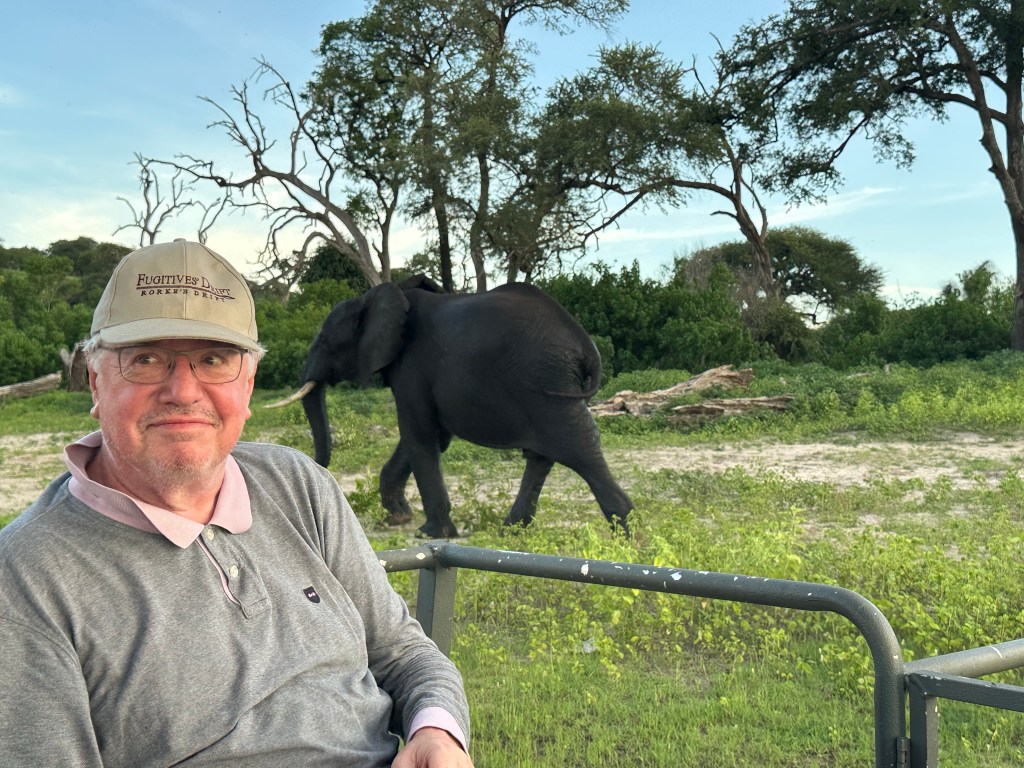
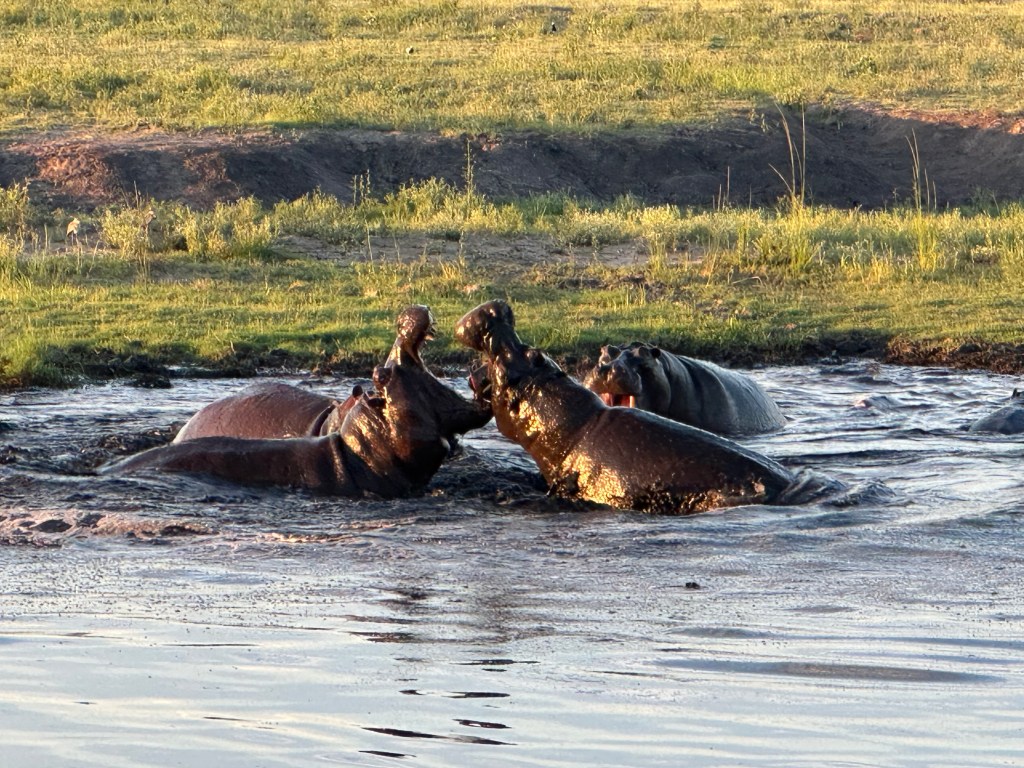
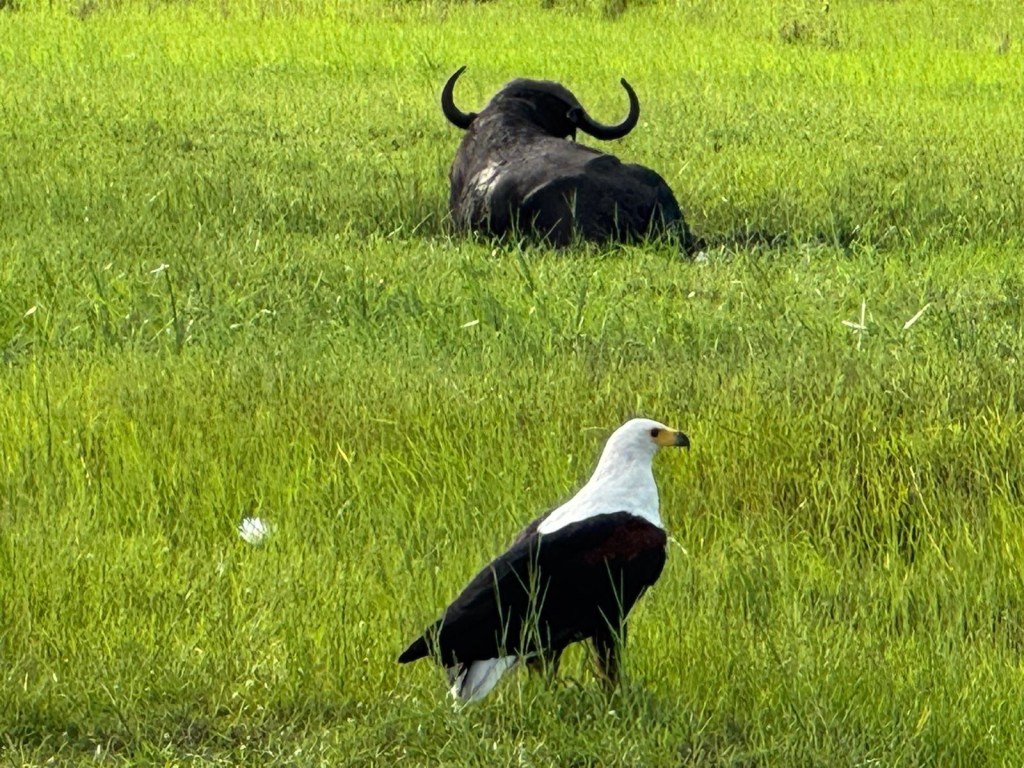
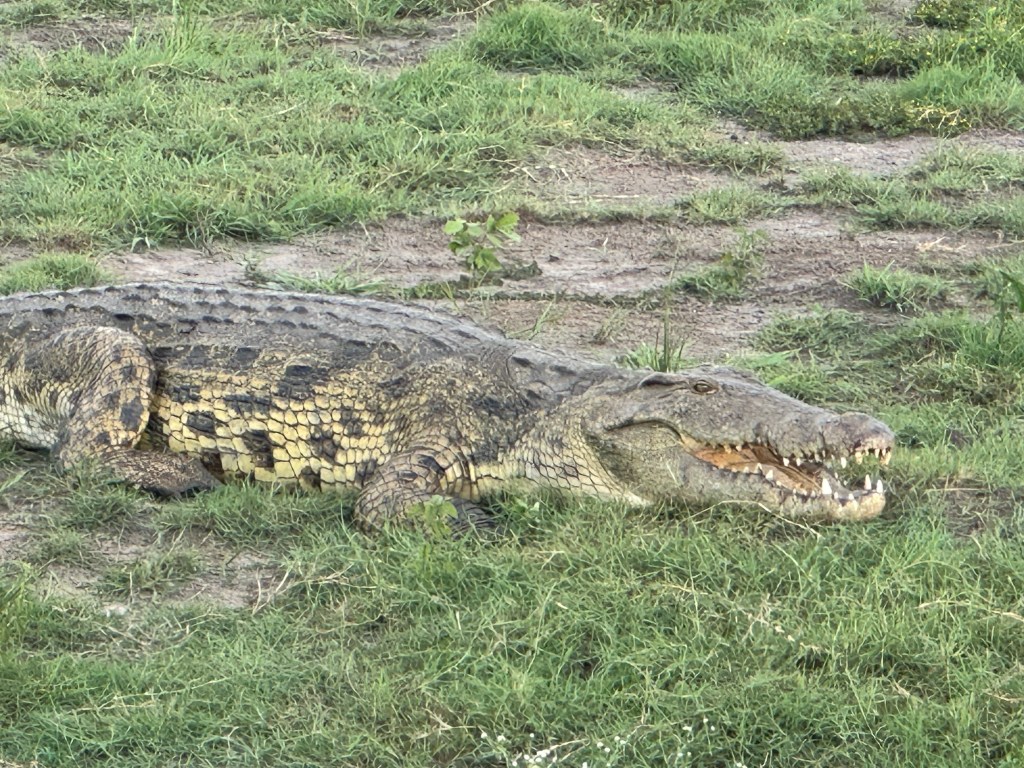
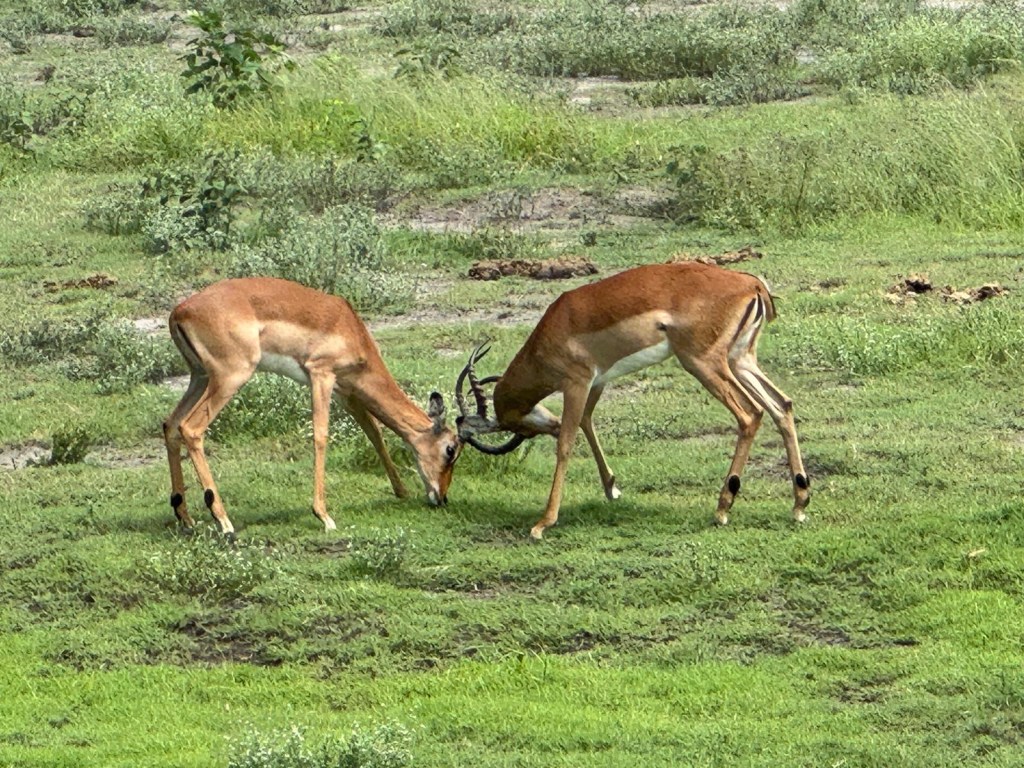
Chobe National Park lies in the north of Botswana and covers 11,700 square km, larger than Devon and Somerset combined. It was created a national park in 1967 and is known for its large population of elephants estimated to be over 45,000. The destruction caused by elephants is such that culls may be considered. We stayed at a lodge just outside the park with views across the Chobe River to Namibia. Our activities were consequently both land and water based.
Shortly after a curious elephant approached our boat !Hippos – what seemed to be a vicious fight was, our guide told us, a mother telling her sons it was time to leave home and make their own way in the world
Our first lodge in Botswana was only a 20 minute drive from the border with Zimbabwe, one hour from Victoria Falls. The border crossing is very close to the world’s only quadripoint where Botswana, Namibia, Zimbabwe and Zambia all meet – some locals refer to it as BoNaZaZi. We could see Namibia from our lodge and during our trip to Victoria Falls we walked across the bridge to Zambia. This could be done on a “day pass” used by locals for shopping/trade and tourists to avoid the need to pay for a second Zimbabwe visa.
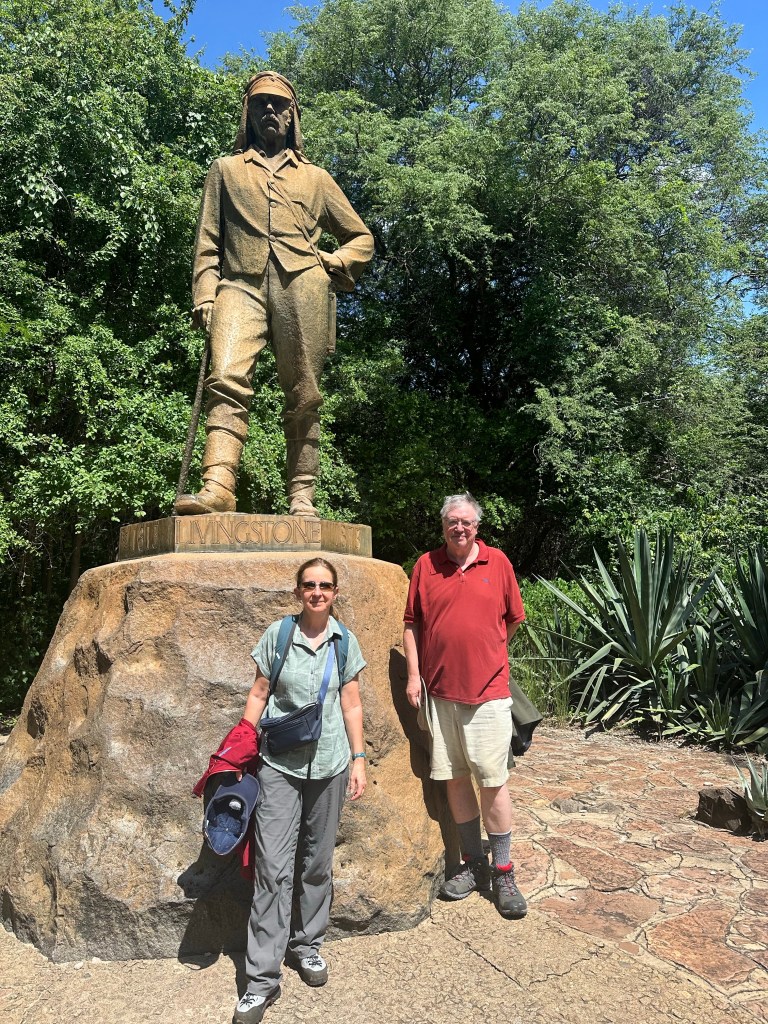
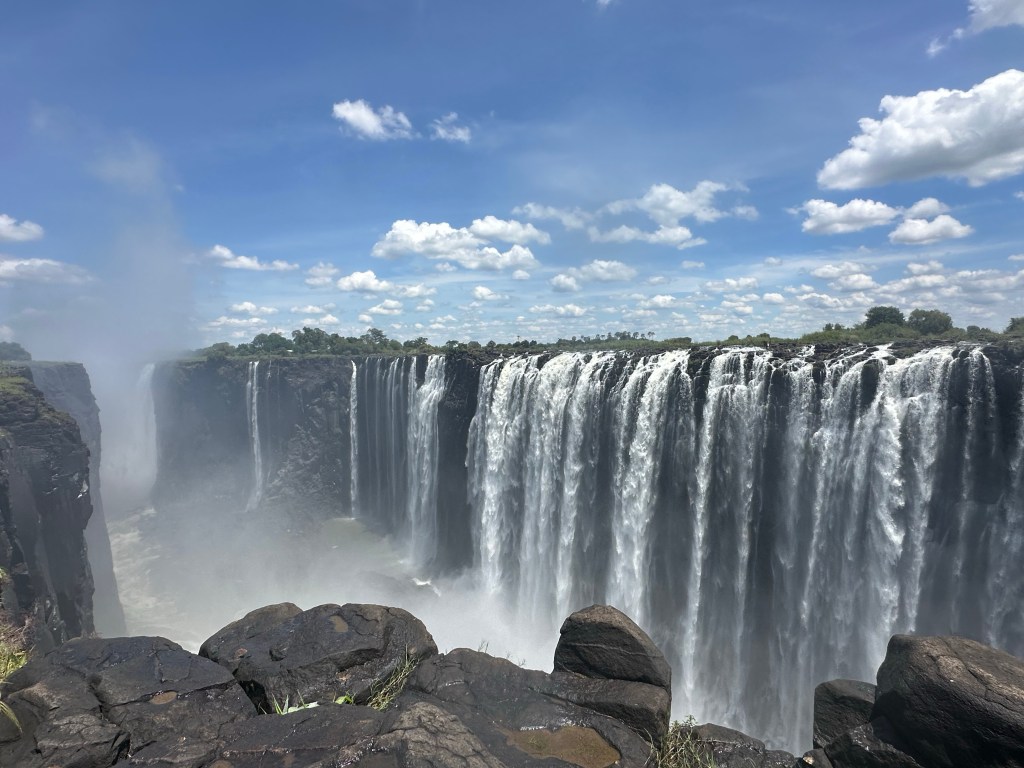
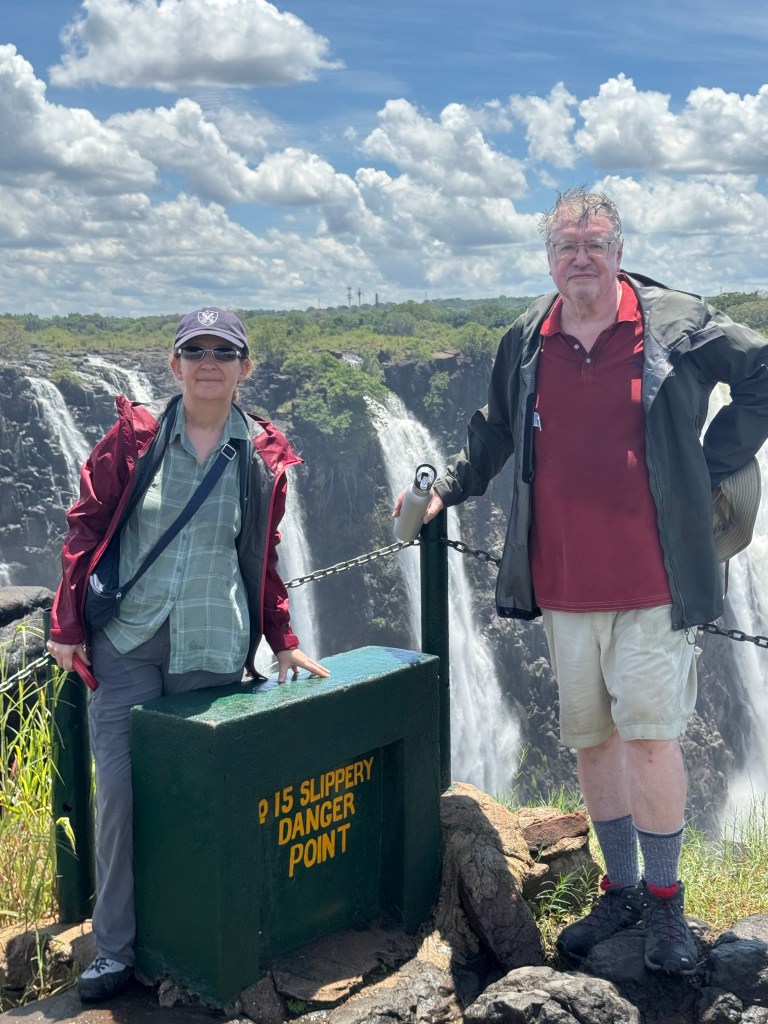
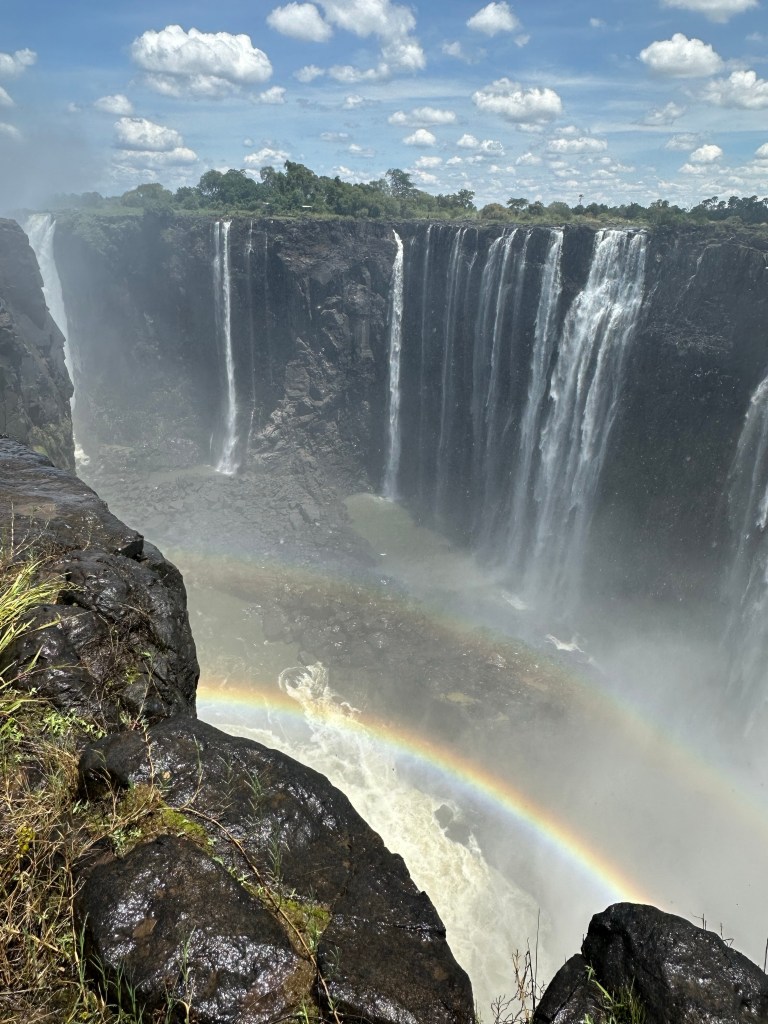
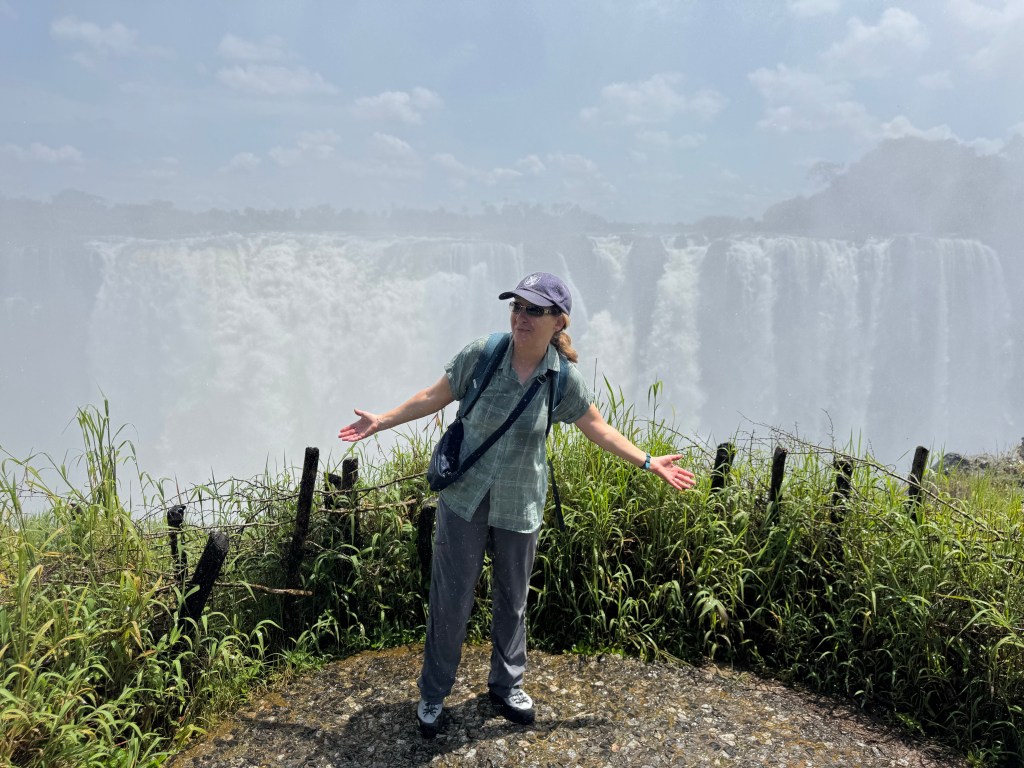
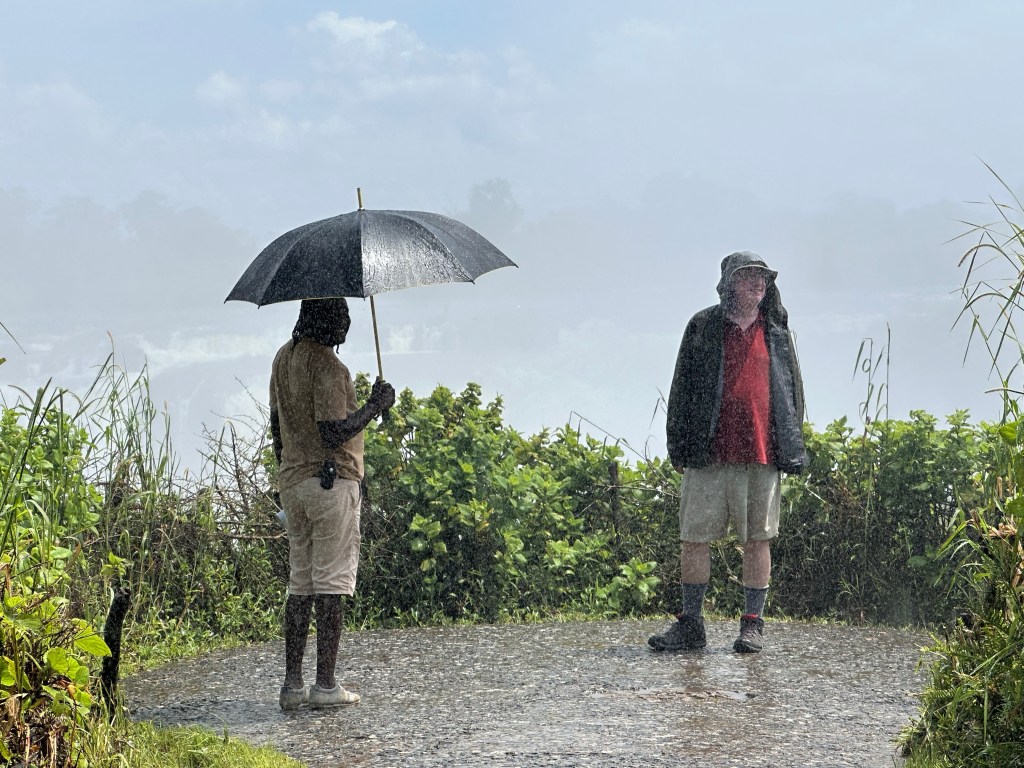
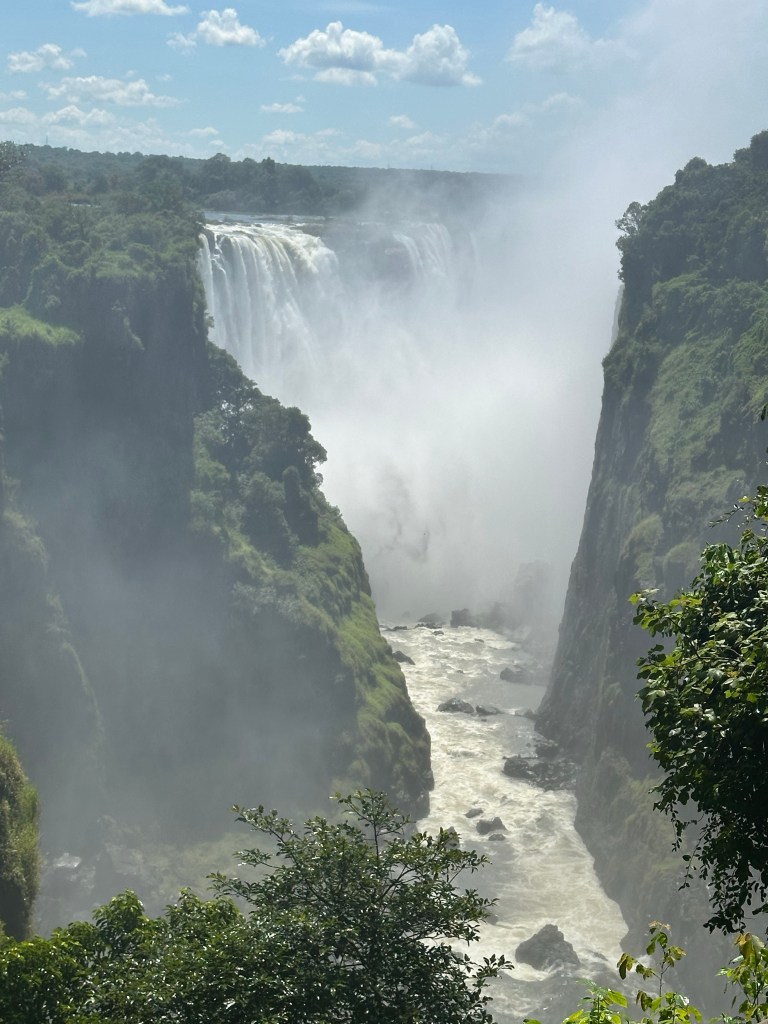
The first European to discover the falls was Doctor David Livingstone who first saw the falls on 16 November 1855. He named it in honour of Queen Victoria, its local name being Mosi-oa-Tunya – the smoke that thunders. It sits between Zimbabwe and Zambia on the Zambezi River and is classified as the worlds largest falls, based on combined width (1,708 m) and height (108 m), with other falls claiming the spot based on different combinations of measures ! The volume of water varies considerably by time of year; when we visited it was considered around a mid point.
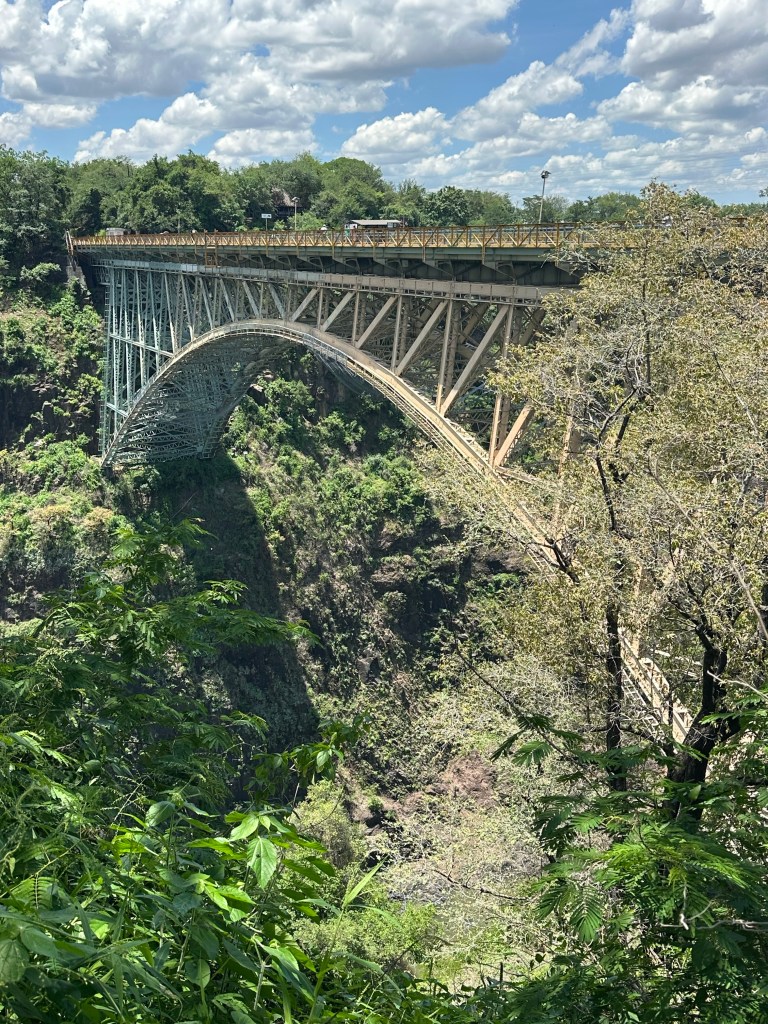
As part of the grand, but unfulffilled, vision of Cecil Rhodes to build a railway from Cape Town to Cairo a bridge was built over the outlet gorge of the falls. The bridge was prefabricated in Darlington and completed on site in 1905. It consists of a single lane road, railway and two footpaths and has only ever needed minor repairs and painting since its construction.
Botswana is a country, approximately the size of France but with less than 2.5 million people making it one of the world’s least densely populated countries; 70 % of its land falls within the Kalahari.
Botswana became independent in 1966 and is the longest uninterrupted democracy in Africa, although until the 2024 elections it was governed by the same party. In 2024 a major change in politics resulted in the election of a left of centre coalition, promising to better distribute the country’s wealth.
Botswana has one of the fastest growing and highest GDP per capita in Africa derived from its natural resources and tourism. The country’s largest diamond mine is 50 % owned by the government.
After a 400 km drive lasting just over four hours we arrived at Sandton, a suberb of Johannesburg, the largest city in South Africa. The city was founded on the back of the gold rush in 1886 and within 10 years it had a population of 100,000 people.
We stayed for a couple of nights prior to flying to Botswana, but took the opportunity to visit The Wanderers to watch Johannesburg Super Kings versus the Durban Super Chargers in the SA T20. The Wanderers, built in 1956 to replace the old stadium, has a capacity of 34,000 and is known as the bullring because of its intimidating atmosphere for visiting teams. We could see why – although the stadium was not full, it was extremely noisy with most people having whistles. It is one of the highest international grounds at 1,640 m; Kingsmead in Durban which we visited earlier in our trip is one of the lowest at 3 m. The game we went to in Durban was rained off, however this match was a first for us – play delayed by lightning , but no rain. After the lightning delay of almost an hour, Durban managed to win (against their recent lack of form) in a 16 over second innings run chase.
Road from Ladysmith to Johannesburg- mountains giving way to mile upon mile of flat farmlands. We saw Bethlehem and Newcastle sign-posted not far from each other Moeen Ali plays for the local team – we saw spectators wearing Moeen beards !When visiting the bar is a matter of personal safety!
Nambiti Game Reserve is a private reserve of 10,000 hectares created in 2000 by the purchase of six farms by two businessmen. It has all the Big 5, with only leopards not having been introduced. Leopards are the most difficult to see (and we did not) as they had been hunted by the farmers for 200 years to protect their livestock and so still have a fear of the sound of the game drive vehicles.
A number of the animals are tagged for research and safety purposes (in case of escape from the reserve). The tracker locations are not shared with the guides, so seeing the animals with smaller populations depends on the guide’s knowldege and skill.
There are a number of lodges in the reserve, but each is relatively small and during our visit, not fully occupied. This together with the guides’ respect for the animals, mutual cooperation and size of the reserve means that the guests enjoy the animal sightings in a calm natural environment.
Sani Pass is the only access to Lesotho on the eastern side. A tar road leads to the South African border control. The actual border, with the Lesotho border control, is a further 8 km away and at 2,876 m. It was soon clear why the South African border control is not on the border. The 8 km between the crossings is a single lane rough track, very steep with winding hairpins and only accessible in a 4×4 with a local guide.
Once on the Lesotho side of the border, the road leads onto a vast open plain, with small settlements and populations earning a subsistence living from sheep farming. Rather incongruously the road becomes new high quality tar. Paid for by the Chinese, we were told; part of the vast infrastructure spend reaching into all corners of Africa.
The views were well worth our “African massage” journey and early start. As well as a visit to a local village (a little touristy, but very few tourists and an important source of local income) we enjoyed a short walk and a pub lunch at the highest pub in Africa.
Lesotho is perhaps a geographers dream; some facts
only country in the world entirely above 1,000 m; lowest point (in the west) is 1,400 m
only country in the world with a hat on its flag (other than crowns)
the largest of the three countries fully surrounded by another country
home to the highest pub in Africa
one of only three reamining African monarchies (the others being Morocco and Eswatini)
Lethotho means “kingdom in the sky”, justified by its mean elevation of 2,161 m.
Just before South African border crossings South African border control
The beginning of the 8km “no-man’s land”
Towards the end of “no-man’s land”Just inside LesothoLadies singing for the tourist, although we were equally taken by the “baby-yoga” on the right. The new tar road in the background
Cleopatra’s Mountain Farmhouse sits on the Mooi River in the foothills of the Drakensburg at approximately 1,500 m. Accessible only via dirt roads, with the route options being rough with lots of potholes or very rough with worse potholes. We took the former on recommendation, although the latter is shorter (and shown on google maps). Although only 40km from the closest town, Nottingham Road, the journey is over an hour, but worth it for the stunning scenery and isolation (hardly surprising). Cleopatra’s mountain has to be viewed from the right angle, with a little imaginination, to see the resemblance.
Close-by, at just below 2,000 m, is the Highmoor Nature Reserve with hiking trails and fantastic views of Giant’s Castle mountain in the Drackensburg. On the day we visited there were only two other walkers in the reserve.
Cleopatra’s Mountaim (top), the farmhouse (above and below)Giant’s Castle
The right horn of the Zulu army (4,500 men), held in reserve, sought its own unauthorised share of the glory, travelling 10km back to Rorke’s Drift to attack the British left at the outpost. Rorke’s Drift was a former trading post, operated by an Irishman with a drink probelm who had killed himself, subsequently serving as a mission. Chelmsford had left 105 British officers and men (mainly of the 24th Warwickshire, now Royal Welsh), 36 men sick with fever and dysentry and 14 ancilleries including a doctor and a pardre.
On hearing of the approaching Zulus the officers in charge Ltds Chard and Bromhead, built makeshift defences between the hospital and storeroom using wagons, bags of meal and tins of biscuit rations. The Zulu attack began at 4.30pm and continued through the night. By the times Chelmsford’s advance force arrived at 8am on 23rd January, the Britsh casualties were 17 dead and 15 wounded with the Zulu dead around 500. Against the odds, Rorke’s Drift had been held and subsequently 11 VCs were issued to the defenders.
Rorke’s Drift – former hospital in foreground and church to the leftJames Rorke’s grave with Buffalo river in the backgroundSite of the final stronghold where the sick were ferried from the burning hospital by their heroic colleaguesWreaths were laid at three sites at Rorke’s Drift on the anniversary
The middle column of Lord Chelmsford’s invading force travelled the 10km from Rorke’s Drift to Islandlwana. At 3.30am, following reports of Zulu movement, Chelmsford set off in persuit with 3,000 men leaving behind a camp of 1,300 men. The camp had no agreed leader nor proper defences, so was unprepared for battle with the main Zulu army, which had by passed Chelmsford’s force. The Zulu army, in a buffalo formation (two horns with a chest) were armed with assegai (spears) and shields and some old muskets. The centre and left wing, around 20,000 men, attacked around noon and by 3pm it was all over, with the added confusion of an almost total eclipse towards the end.
Aside from 55 men, all the British troops were killed. The dead were disembowelled, as a result of Zulu ritual to free the soul, and left on the battlefield. Chelmsford returned after dark, so was unable to see the full carnage until dawn.
Lt Melville, given the task of trying to save the regimental colours, set off on horseback looking to cross the Buffalo River. At the crossing he was assisted by Ltd
Lt Coghill who had suffered an injury chasing a chicken for Chelmsford’s dinner. They lost the colours crossing the river under Zulu pursuit, although they were subsequently recovered from the river. They lost their lives on the Natal side, overcome by Zulus and became the earliest recipients of posthumous VCs when they were first awarded in 1907. Their bodies are buried where they died, which now lies within the property of the lodge where we stayed, Fugatives Drift.
The Isandlwana site. The dead were buried by colleagues who returned to the site four months after the defeat. Due to the scale of casualties and difficulties identifying individuals the graves are mass graves marked by piles of stonesOverlooking Buffalo River where Melville and Coghill crossed. Our guide for the hike from the lodge was a “gappie” working at the lodge prior to starting his history degree Graves of Melville and Coghill where they fell soon after crossing the river.
The first Zulu king, Shaka, built from a small tribe the Zulu nation through war and conquest so that by 1825 it covered 30,000 sq km, roughly the same size as Scotland. Following assassinations by his half brothers, in 1830 the Zulus fell into conflict with Boers looking for more land. The British were also looking to expand from their base in Durban and laid claim to land called Natal, named by Vaso de Gama as it was discovered on Christmas Day. Natal bordered Zulu land, separated by the Buffalo River. The discovery of diamonds north east of Cape Town in 1867 and the successful confederation of Canada in 1874, led Lord Carnarvon to seek a plan of confederation in South Africa.
As a result of spurious border infringements by the Zulus, across the Buffalo River, the British issued an ultimatum to the Zulu king, Cetshwayo, which included the disbandment of the Zulu army and other totally unacceptable demands. The British in Natal had been instructed not to start a war because its forces were stretched at the time. However communication to and from London took over a month, giving the comander, Lord Chelmsford some leeway. The ultimatum ran out on 11 January 1879 and Lord Chelmsford led the middle of three columns across the Buffalo River at Rorke’s Drift. The column comprised 4,700 men and Chelmsford was looking for a quick victory over the 25,000 Zulu army.
The lodge where we stayed has become a centre for visiting the sites of two of the battles, Isandlwana and Rorke’s Drift, both famous in British military history – respectively as a spectacular defeat and equally spectacular victory. The battles took place on 22 and 23 January – we arrived (coincidentally) on the anniversary. We missed the reenactment at Islandlwana at which the current Zulu King and 45 British troops were present. However we were invited to attend a regimental dinner hosted by our lodge for the troops and local dignitories, around 90 in all. We also attended the rememberance service, wreath laying and inspection of the troops the following day at Rorke’s Drift.
This fortunate coincidence, together with the vivid story telling by the lodge’s expert guides made for an extremely interesting and memorable experience; far better than any classroom history lesson !
Fugitive’s Drift LodgeCommemorative dinnerCommemorative dinner – we sat with the lodge owner, a Zulu prince, the Royal Welsh pardre, lance corporal and several senior officersInspection of troops, including by our new acquaintance, Zulu prince “Zac”Service of remembrance, conducted jointly by the local pastor and the Royal Welsh pardre. A fusion of British Army precision and timing and the Zulu equivalent (being polar opposites !). The Zulus prevailed including a 45 minute delayed start for the VIPs to finish breakfast Overlooking the Isandlwana battle site, from where our guide (below) explained the unfolding of events. The white marquees were still there from the reenactment Our guide’s grandfather and great grandfather fought for the Zulus at Isandlwana